Friday, 7 June 2013

2 Weeks In The Garden

I was away on a family matter, and upon returning to see what 2 weeks of rain and sun (and tending by my helpful husband) had done for the garden plantings, was welcomed by blooming flowers and lush vegetation in the perennial beds. 


One of our many clematis plants, which will bloom a second time in the fall if the weather is right.


An established clump of delphinium, going on four summers now - the tallest reaches over 8 feet.


The main perennial flower and herb bed, backed with honeysuckle (middle), an early clematis on one end, and an evergreen clematis at the far end, which smells heavenly in the spring covered in small white flowers. Hollyhock, Columbine, Lily, Calendula, and several other flowers will soon add bursts of colour. Purple Coneflower and Black-Eyed Susans will come out for a bright show in the fall. Everything is popping up through a living mulch of alpine strawberry and very prolific oregano. Please ignore the chicken wire - it's there for a very good reason!

In the vegetable garden, not much had changed, though a few seeds had sprouted, the kidney and soy beans were up, and the only casualties of pests were some of my optimistically planted winter squash.  Vine borers are less interested in my summer squash plants, but seem to find my winter squash transplants no matter how I try to hide them among herbs and flowers.

There are still some promising squash candidates in the tomato hoop house, but I won't get too excited until they size up a bit and are looking more vigorous.

The garlic is starting to produce scapes, and the shallots were sending up flower stalks, which were cut down at the base per my internet information search. The very tips of the leaves are drying up, so they may be ready for harvesting ahead of the garlic.

The next order of business was to open up the hive and do a full inspection, having seen odd comb building and drone brood before I left, I was curious what we would find.....

There was some minor attachment to the sides of the hive, and some continued irregular building, but with much less crossover than before, meaning less damage upon prying the bars apart.

Then Adrian noticed what I had been assuming we might find...


These large, irregular, downward-facing cells appear to be queen cells. There are some drone cells present on the periphery of the brood chamber (and visible in the bottom picture, with the slightly rounded covers- not flush with the comb as in a worker cell), as well as a notable number of drones wandering about in the hive.  We still have not been able to visually identify our queen, but it does look like there has been a reduction in egg laying, and a portion of the brood chamber is vacant, though well-maintained.  I'm not sure if the queen that came with our package is being replaced due to some change in behavior that the colony has been alerted to, or if this is simply a seasonal swarm preparation.  We may simply have opened the hive right after a large number of bees emerged. We made sure there were several new bars added to expand space, so we don't believe that they are feeling crowded.
This is a all a new experience for us, and my research tells me that the colony knows what it needs - we'll have to wait and see what the next few weeks brings, and perhaps try to build or purchase a second hive to home the swarm (which should include the original queen).  Our current top bar hive can be temporarily used to house a swarm with a board dividing the two colonies and an extra exit hole, so that may be an option if the swarm decides to stay close enough for us to capture it.
We'll go back in this week, to see if the cells are being tended. It takes about 16 days to 'make' a queen from point-of-lay, so we may be seeing some interesting behaviour soon. The colony continues to be very docile and largely unconcerned by our interruptions in their work.

Thursday, 16 May 2013

In For A Penny

We went into the hive for an inspection, and to see how the colony had managed with the broken comb. What we found was a mess. The new comb they were building was not in neat lines, following the bar, and more of the comb was stuck together at the top. It appeared they were trying to incorporate the comb lying on the bottom of the hive - unfortunately, there was still some brood they were tending.


The new bar had a collection of small starts, placed side by side and bulging at the top. We made a decision to pull the bar, which was mostly empty comb, and hope that the bees would start fresh, lining up against the older, straighter comb.

 
Adrian brushed the bees into the hive, and we pulled the comb to salvage the wax.  Now we just hope the bees will bounce back from all of the manhandling we've done.


Saturday, 11 May 2013

Happy Chickens

We've been working to get the garden ready for the new planting season for a few weeks now, moving mulch and topsoil, weeding beds and repositioning volunteer plants. The tomato, squash and cucumber seedlings have been hardening off for the past several days, and are almost ready for transplanting.

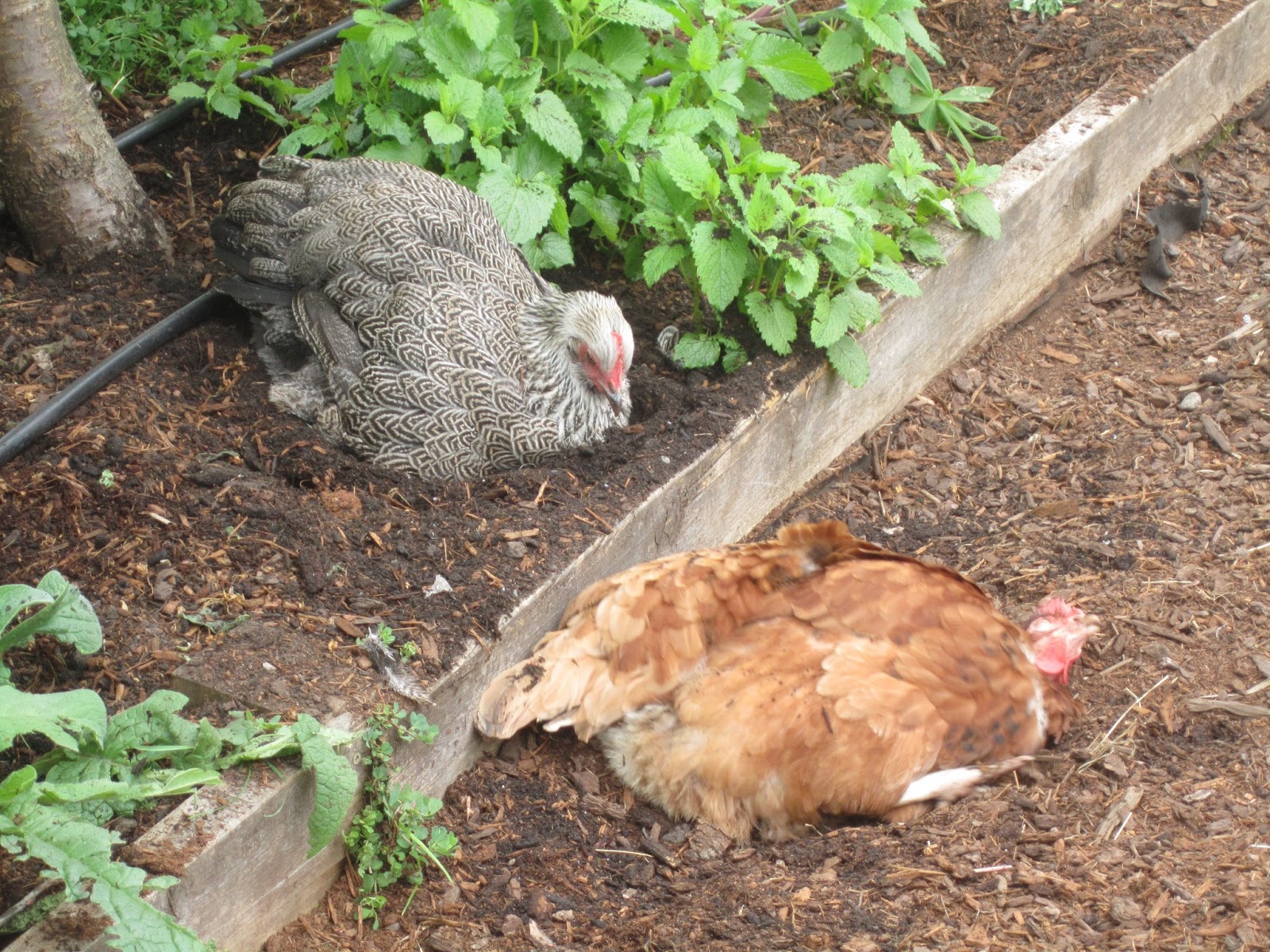
On the other hand, while we make everything neat and tidy, the chickens are following behind us and creating their own idea of perfection - like trimming all of the barley they can reach through a wire barrier put up to exclude them, nipping bites out of all of my comfrey leaves, and making dust-bathing holes in the middle of my nicely-mulched garden.


They just look like they're having such a good time...I can neaten up later.

Monday, 6 May 2013

The Books Told Me it Would Happen

We did a hive inspection today, having put it off due to heat and scheduling on the weekend. It was still too hot today - 27 degrees is weather more appropriate for July - but I was fairly certain they would be out of sugar syrup, and I needed to know if they were running out of room.


The original bars where they had built comb and reared brood were already being used again. The bees in the hive have visibly increased in numbers, and these combs already had new larva in them, which meant the workers had cleaned and prepped the cells after their first inhabitants had emerged. The wax of the used cells will continue to darken with use, as there is some debris left behind by the process.

 
You can see a fairly distinct line here, dividing original comb from the new extension - the new wax is very pale.

Unfortunately, as sometimes happens when you allow bees to build their comb without a structured guide as in other hive types, they build with a bit of a curve, or sometimes ignore the dimensions altogether. On a few occasions, I've gently bent curving ends back towards the centre of the top bar, but today they had built across two bars, and coaxing it apart did some damage.


This is built on one bar , forcing the larger piece out of line and causing crossover and a weak connection to the bar itself. This would only continue to make working in the hive more difficult as the season progressed. I gently removed the smaller piece, which they were building to fill a gap, and which had no contents. The bees will salvage the wax and use it to build new comb.
 
Here's where it went wrong - I gently tried to move the larger comb back in line with the bar, but my intrusion had already done some damage, and the heat was making the wax soft. We returned the bar to the hive, but the comb slid off to land on the floor of the hive.
 
 
Now we just have to keep our fingers crossed that the comb didn't squash the queen, step back and let the colony repair the damage. Most of the literature I've read on the subject assures you that sooner or later you're going to do some unintentional damage, and that the bees will fix what needs to be fixed  - I still feel pretty bad about it though.

Friday, 3 May 2013

More Signs of Spring

The promise of a new gardening year is always exciting, and seeing your perennials fill out and new seeds sprout in the beds reminds you why you spend all that time pulling weeds and tending your aching back. For me, some of the first things I enjoy out of the garden (along with the last of the bolting winter greens) are our herbs. The tulips are lovely, and the smell of the evergreen clematis flowers lasted for weeks, but I'm really about growing what I can eat.

In our climate zone chives, celery leaf, sage, rosemary, parsley, oregano and thyme will overwinter handily. We use them regularly to accompany many dishes, and sometimes even get a mid-winter harvest if there's a warm spell. Adrian's celery allergy does not extend to the leaf variety, so we grow it for fresh use, and save the generous heads for their seeds to use in cooking and to plant in the garden as well. I also grow lovage, sweet cicely, lemon and lime balm, lavender, bronze fennel (for seed and to attract beneficial insects), sorrel and I'm sure some other plants that I'm forgetting at the moment. I seed annuals like cilantro and basil both in seed trays and directly, to cover my bases, and dig up and re-plant herb volunteers from my borders when I need to fill empty spaces.

Today we were able to enjoy home-made egg salad for our lunch, made with a generous helping of those herbs (celery leaf, both fresh and seed, chives, parsley, and oregano fill out a salad made with backyard eggs).


And tonight with dinner, we'll be having something else that's a sure sign of spring - rhubarb.


After sharing a few stalks with my neighbour to celebrate the harvest, I threw together a pan of Rhubarb Blondies, with the addition of homemade apple butter to make up for missing eggs - I used all our eggs making the salad, and then found only one fresh-laid egg in the nesting box for my baking - not that I'm blaming the chickens for my lack of forethought.


This will taste heavenly after a few hours of yard work, hauling mulch and moving the chicken tractor back onto the grass. It's time to clear our hoop house space for tomato planting preparation, and the chickens don't need the wind protection or heated  waterer and heat lamp any more.


Thursday, 2 May 2013

They're Aliiiiiiiiive!

Today was sunny and warm. The honey bees were buzzing about, and we gave the momma rabbits some outside time with their little ones. A check in the 'attic' of the mason bee house confirmed what I thought I saw - that some of the cocoon inhabitants had made their way out into the great, wide, warmer world in search of pollen and a sip of water or nectar.


If you look closely, you can see the holes made in the cocoon walls by the emerging bees.

The apple trees have slowly begun to blossom, much later than the pear and cherry trees here.


One of the girls from the honey bee colony is at work collecting pollen from an apple tree - and below in a clematis flower.


What a lovely day!


Wednesday, 1 May 2013

I Woke Up To Frost This Morning

My body clock seems to think that 6 a.m. is a good time to wake me for the day - regardless that I had just spent several hours the previous day helping reinforce and extend fencing in full sun and was feeling the effects. I grumpily trundled to the bathroom to splash some water on my face, looked out the window, and noticed that the canopy on the gazebo in the yard was sparkling in the morning sunshine.

Crap.

Out to the kitchen to look at the thermometer, yep - Zero degrees, and yep, there was a thin crust of ice on the barbecue cover.

And I put the mason bee cocoons out yesterday morning because I had been watching the weather forecast which lied to me.

Checking in with the chickens and rabbits, I stopped by the bee house to lift the cover and see if anyone had been woken from hibernation yesterday, and at a glance all of the cocoons are still whole. Hopefully, the weather will pick up today, as it is supposed to, and we will have no more of these chilly nights. If I had woken up a half-hour later, the frost would have been burnt away, and I wouldn't be left wondering if there was any negative impact on my cherry trees....time will tell.