Just an update on our bee swarm - the bees that we managed to scoop back into our hive the day after they decided to leave decided to leave once more. Apparently they took a portion of the workers from the hive that remained, as an inspection last week showed that the queen was indeed laying, but the numbers were nowhere near the 10,000 bees that came out of the package the day we installed it - perhaps 2-3,000. They're also building across the bars and up the sides of the hive body with fragile comb, making inspection difficult and correction of their mess too risky. I will be going back in this coming weekend, to see how disruptive my last inspection was, and to try and remove some of the poorly build comb in the hopes that they will build again. Better a cross-comb hive of honeybees than no honeybees.
Showing posts with label bees. Show all posts
Showing posts with label bees. Show all posts
Monday, 1 June 2015

Saturday, 16 May 2015
Where bees come to Front Porch Farm, leave, and are (hopefully) convinced otherwise...
We waited for what seemed like forever to get the call to pick up our packages of local Carniolan/Italian cross honeybees, locally bred on Vancouver Island. I watched as the first flush of dandelions and then the fruit trees were visited by other local pollinators as well as our Mason bees, and worried how long I was going to need to feed our package bees for - if the local pollen and nectar sources were in a lull when they finally arrived. Our beehives had been sitting vacant since the beginning of the year, so I raced to pick up our order when I was finally contacted.

So we got the bee packages installed the morning after they arrived (on a rainy evening), after making sure to feed them sugar syrup several times while they were trapped in their package. On Thursday morning, the girls were gentle and quiet - or as quiet as you would expect after being shaken into a strange wooden box. The syrup feeders were set up in the hive bodies, and the entrances reduced to allow them time to settle in and make sure they had protection from intruders.
I was out in the garden on Friday afternoon, planting some seeds, when I heard quite a bit of loud buzzing. An investigation led me to the biggest cherry tree in our orchard, where there were thousands of bees swirling about around the top branches. My first thought was that they were reacting to the sunshine and still orienting themselves to the new location, but I wanted to keep an eye on the process. About 45 minutes later, I saw a small bundle of bees start to form up, on a branch about 25 feet in the air, near the middle of the tree canopy. Not good - the likelihood was that there was one of my new queens in the center of that mass, and I ran to get a pillowcase and don my veil and gloves, wondering how I was going to get up there with the ladder all by myself. By the time I got back outside, the air was clear, and the swarm was gone. There were still bees flying about both hive entrances, though they sounded considerably more agitated. I didn't really want to further disturb them, in case the remaining colony decided it wanted to move on as well. I waited for the day to cool off, thinking that at that point there was really nothing I could do to turn back the clock.
Just after 7:30, I got suited up and wandered with apprehension towards the hives. It was too quiet, and I soon discovered that one hive was empty, while the second had less than a quarter of the bees it had contained the day before (as a mental image, these were 3-pound packages of approximately 10,000 bees). We're still not sure if there is a queen in the hive, as there's minimal chance to find her with them clumping and building comb in an otherwise barren space - but they sound calm and are going about their business.
This morning, after a very bad night's sleep, and an e-mail conversation with the beekeeper who sold me the packages that ended with 'sorry I can't help you,' as well as a vague reminder that top bar hives aren't standard practice and there's never any guarantee with hiving, I got up with the early morning light and slowly wandered about the orchard and lawn, peering up into all of the trees, and listening hard for the sound of several thousand honeybees.


In the end, the swarm I found was on the mulch at the base of one of the plum trees, and they were almost perfectly silent. I got Adrian out of bed, and the 2 of us suited up and prepped a couple of light cardboard boxes, in the hopes of being able to scoop the swarm and dump them back into the hive body.
Unfortunately, they had settled in and around several plants, and there was quite a bit of dirt and mulch that went into the box with them as we tried to ensure that we got the marked queen. They were not happy being disturbed, and I was sweating very nervously, being stung while we both had our heads and hands down low, trying to find that green-dotted body to ensure we managed to take her with her workers. The air was filled with loud angry buzzing then, and I could actually feel the vibrations from the bees landing on me as they announced their warning.
The box contents were 'dumped' into the hive body as quickly and gently as possible, given the amount of plant matter and dirt that had to be scooped up in the process.


About 45 minutes later, there was still a small clump of bees on the ground, so we collected them and quickly put them in the hive as well, just in case they had been protecting our queen. We've closed up all the entrances to the hive, and they had managed to gorge themselves on an entire quart of sugar syrup before absconding, so they won't be hungry for a bit. Hopefully a bit of time will help things seem and smell a bit more like home, and help them decide to set up shop where we put them in the first place. Fingers crossed.
Thursday, 8 January 2015
Bittersweet
I was out examining our remaining colony of bees today, since the clouds ran out of rain and the weather changed to cold and misty. There are still a significant number of cranky girls in residence, so I again left them alone for a clearer day with better light, and a chance to do an inspection in my veil with another set of hands. There is still the possibility that I missed a queen in residence, so I will make very certain I know what's going on in the hive before I decide what to do next.
The comb that had been accumulating in the kitchen was partially dealt with over the holiday slowdown, and I cut out just the parts of comb that were completely capped - signifying finished honey that won't spoil or ferment in storage. I then broke that comb down to put through my very basic honey extractor. The usual method for honey extraction when you're keeping a top bar hive is called 'crush and strain,' which is a very apt term.
.JPG)
In the kitchen, I separated out only the comb that contained capped honey - the remainder of the wax, and the top bars were put to the side.
.JPG)
With some patience and my large potato masher, I made sure that I broke up the capped cells, reducing the wax and honey to a mixture that could be strained through the three grades of mesh that came with my handy-dandy crush and strain contraption.
.JPG)
Yep, a food-grade bucket with a 'honey gate.' Don't worry - it wasn't expensive!
With the help of the heat from the woodstove, and lots of towels and newspaper to catch any spills, I slowly added the mashed mixture to the first of three sieves, scooping out the spent wax that remained between additions, and we patiently waited.

In the end, things got quite sticky, but it smelled wonderful while I was working, and after a couple of days we were able to cover more surfaces with towels and gather our small harvest of honey.
The wax itself will be rinsed outside to make sure we don't add wax debris to our plumbing, then melted several times in water, to allow me to remove as much debris as possible. Finally, I'll strain it through cheesecloth or an old t-shirt into the waxed milk cartons we've been collecting. The cartons can simply be torn off the cubes of pure, cooled, solid beeswax in the end, and the wax can be used to make candles and salves in the future.
Wednesday, 26 November 2014
Varroa Destructor
My investigation into what happened to our strong, 'ready-for-the-winter' hive is still rather circumstantial. I intend to do more research this winter, and to become involved in the beekeeping community on Vancouver Island. There are local monthly meets after the rush of Christmas is over. It disturbs me greatly, but we may need to start chemically treating hives while we adjust to the reality of keeping bees in our new location and to the current threats to their safety. Hopefully I will find some beekeeping hobbyists who can share their experience and advice on the least invasive, least poisonous ways to help our future colonies remain strong and healthy.
The fact remains that there are not enough bodies, and no visible damage to explain what really happened. That is, after all, the confusing situation with honey bees the world over. I tend to lean towards the idea that a combination of stressors is causing the decline in bee populations. Was the move too much for them? Did someone nearby spray chemicals? Was there some form of infection or spore? The only obvious answer to our loss that I could find was the ominous presence of varroa mites in the hive.
As we started out in this hobby, and after significant study, I opted to keep bees in a top bar hive - specifically because it was believed the bees were more likely able to exclude varroa in the building of their own comb, and that the open screen bottom which is part of the hive's design means that mites which fall off of bees will fall completely outside the hive. My intent had been to give my colonies the best chance to live naturally with the least amount of interference necessary. My last hive inspection of the small, remaining colony still in short-term residence showed a significant population of varroa mites - which I had not seen at all in our first year on the Mainland in our thorough (every bar out and examined) once or twice-monthly inspections.
The varroa mite is considered one of the biggest dangers to honey bee populations, and its presence in a hive can result in the transmission of disease. Deformed Wing Virus is one of the major concerns for infection, causing wing and abdomen malformation, pupa death, and lifespans of less than 48 hours for those bees affected. Over the summer, I viewed less than a dozen bees with malformed wings, which may even have been a result of the virus being carried by foraging bees returning to the hive. Now, in the remaining comb, I can see the remains of several bees that never completed their emergence, likely indicating the varroa mite population had outnumbered the brood being laid to the point of killing their hosts.

The winter bottom board - taken off to examine the debris which fell through the bottom screen in the time it took for the bees to disappear. The concentration is below where the brood chamber was located when we prepped the hive for winter.

Up close - the shiny brown ovals are dead mites that have fallen to the bottom of the hive.

You can see the varroa mite latched onto the worker bee in the middle of this picture.
I don't know if the presence of mites in the hive is the cause of our loss, or the result of an otherwise already-weakened colony. The prior owner of the property was a commercial beekeeper for many years, so that may have contributed to a high mite population in the area. When we arrived on the property, I noted populations of several types of bumble bees and wasps, which traditionally are not affected by the varroa (whose lifecycle is unfortunately so well-synchronized with honey bee brood development). Apparently though, varroa are quite happy to hitch a ride on these local insects and can therefore move about the landscape to areas where they can hope to find a foraging honey bee.
Wednesday, 12 November 2014
Disappointments
Well, the saying goes that bad things happen in threes, and we've had a few whoppers here in the past few days.
The firewood situation is looking a bit dire, and our 'wood guy,' who was supposed to show up yesterday with the remainder of our order, didn't. Apparently he has laryngitis - at least according to his wife's cryptic phone message. We may be better off not getting another delivery from him, but for all I know, he may just show up anyway. I'm glad I only paid him half.

We got our initial delivery stacked - the front of three rows (the back 2 being the majority of our first 2 cords) - and it is sorely lacking in size for the amount paid....maybe 2/3 of a cord, if we're being generous.
We're also going through our wood faster than I had expected. It's probably not helping that we're new to woodstove management and aren't damping it to slow down the burn as well as we ought.


The firewood situation is looking a bit dire, and our 'wood guy,' who was supposed to show up yesterday with the remainder of our order, didn't. Apparently he has laryngitis - at least according to his wife's cryptic phone message. We may be better off not getting another delivery from him, but for all I know, he may just show up anyway. I'm glad I only paid him half.

We got our initial delivery stacked - the front of three rows (the back 2 being the majority of our first 2 cords) - and it is sorely lacking in size for the amount paid....maybe 2/3 of a cord, if we're being generous.
We're also going through our wood faster than I had expected. It's probably not helping that we're new to woodstove management and aren't damping it to slow down the burn as well as we ought.

The new wood splits very nicely. It is indeed good quality - just not the quantity that we agreed on.
Today, while doing a mid-day check on the rabbits, I found that the smallest of the 11-week-old male kits had labored breathing, and looked to be exhausted and in distress. I brought him in by the fire, and could definitely hear crackling in his lungs when I held him to my ear. The nights have just turned quite cold, and I hoped that he might improve in the sheltered warmth. I called a rabbit friend, who agreed that it was probably pneumonia, and we would be needing a round of antibiotics if we hoped to save him. The reality of the situation sank in - butchering day is Saturday. I held him for a short while, and he seemed calm, and then slowly stopped breathing while I cradled him. It was fast. His 2 cage mates have always been bigger and more vital than him, though I did note they seemed to be protecting him this morning when I went out with breakfast and the eagerly awaited morning treat of grain. Goodbye little guy. I'm sorry I didn't realize earlier that you were in trouble.
While I was futzing about with hauling feed and grass out to the rabbits, I took advantage of the clear weather to have a very quick peek into our primary hive.
In the summer, you can hear the buzz of the colony from several feet away - if you know what you're listening for. We had closed up the floor and checked for stores 3 weeks ago, identified the queen and some new brood, and I felt quite confident that this hive was set for the winter. A couple of nights ago, I noticed that there was limited sound coming from the hive, and last night I tapped the wall purposely, which usually results in an increase of volume from the disturbed bees.
And I heard nothing.
A flashlight shone in through the entrance holes showed no bees guarding the entrance, and none visible beyond that.
Today, with a sense of dread, I opened the hive to find maybe 200 bees - as opposed to the literally thousands there might be on a warm summer day. No brood. No sign of a queen, and what looked to be a bunch of bees gorging on honey as they chewed the wax cappings off the finished stores.
A quick look into the secondary hive, the one that I had my doubts about, showed a considerably larger colony and some brood just emerging. No sign of newly laid worker cells. That indicates to me that those emerging workers may be the last of the brood we saw when we tried to transfer some new eggs over (it's 21 days to emergence for a worker). I was moving fast, since it was only 10 degrees at the height of the afternoon. I closed the hive up, and left well enough alone.
As the darkness and temperature fell, I donned my beekeeping veil and gloves, and went out to my formerly strong colony - and pulled most of the frames from the hive. There are still bees inside and I didn't have the heart to leave them without food for however many days they have left, but I'm also not willing to risk robbers stealing the honey that they worked so hard for. The remaining girls won't likely last long in the cold with their numbers too few to regulate the inside temperature. There is no large pile of bodies on the bottom screen, no sign of damage from rodents, or broken comb that might identify robbing activities. The colony is simply gone.

Not the harvest I wanted.
This definitely came as a surprise. I will continue to monitor our remaining hive, but I fear that they too will be gone within weeks as they age. For now, I will examine my bottom board and the hive body for more information in full light, and carefully examine the comb as I salvage the honey that was supposed to see the colony through the winter. In spring, we will have to start again.
Tuesday, 3 June 2014
We Bought The Farm!
Our buyers finally signed on the dotted line last night, so our move to Vancouver Island is a go for the end of this month. Front Porch Farm will be located in Cassidy, B.C., and we're thrilled!
We need to have our bees inspected per the provincial Ministry of Agriculture, and we just found this weekend that our artificial swarm, which contained 3 potential queens, has no brood but lots of pollen, nectar, and honey. The original colony had brood, but minimal stores. There seems to be some confusion.....
We took a chance, and pulled a top bar with the youngest brood we could find, and placed it smack in the middle of the potentially queenless hive. Maybe she just hadn't made her mating flight yet? We have fingers and toes crossed that when we do our inspection this weekend, we will either find evidence of new brood, or note that the bees have adapted one or more of the introduced potential queen cells. It "should" be possible to tell if they've expanded a cell for the development of a larger queen.
Along with the bees, we'll be moving 32 rabbits in 8 cages (we have 3 moms with their litters). On a ferry. In a UHaul. Never a dull moment.
Thursday, 22 May 2014
And Then There Were Two
Springtime brings a burst of new life to the garden, and the beehive is not exempt from the exuberance of nature. Having seen several swarm cells in the making, we decided it was worth our effort to attempt splitting our hive - instead of risking the loss of a large part of the colony in a swarm situation. A 'swarm' cell is a queen cell formed (like it sounds) in preparation for the natural process of swarming. They're located, facing downwards, along the edge of the comb - an indicator that the hive is feeling that it needs to expand in response to growing numbers, or the increased availability of food sources. They want to move, but they're preparing properly. An 'emergency' cell is a queen cell that is formed around an existing young egg that is 3 or fewer days old, and therefore still capable of becoming a queen. These cells normally protrude out of the face of the regular brood comb, to provide more room for the larger queen developing within. These cells normally indicate that something is wrong with the hive or the existing queen - or perhaps that she has been killed. The colony reacts to the loss of her pheromones and attempts to make a replacement.
The trick here, is to convince the growing colony that there has been a swarm, leaving space for expansion and a queen still in charge - they can essentially continue on about their business. This is achieved by removing the new queen cells, and placing them, along with attached nurse and worker bees, into a new hive body along with stores of honey and pollen - it's called an 'artificial swarm.' The additional trick here is to leave the original queen in the original hive body, which can be nerve-wracking when you cannot find her!
At this point, my research indicated to move the original hive away from it's location, and replace it with the new, smaller colony hive body. Foraging workers will return to the location that they left from originally, and should help to ensure that there are enough foraging bees going out to gather more stores to bring back to the new colony as it adjusts to its new home. The original hive 'should' have plenty of workers, and some will become replacement foragers and orient on their new location on the way out - so that they return to that location. Of course, there's always the crossed-finger hope that the bees will cooperate.
Knowing that we were getting close to the time where swarming might become a possibility (queens take 16 days from the time they are laid until they emerge), I headed off to Rona, where the nice guys in the lumber yard made a bunch of cuts for me. The fellow who helped us with supplies for the chicken tractor, and who cut some top bars to size for me last year remembered me.

I picked up some 2x12 spruce boards, some 5/8 inch exterior grade plywood, and a piece of pine shelving....doesn't everyone do building projects in their gazebo?


The shelving board is what we use to build the follower boards (the boards that define the left and right boundaries of the colony in the hive body). Each follower board is attached to a top bar for placement in the hive.

The hive body is built out of 2x12 boards to fit the follower boards (ahem, at least that's the intent - the final product isn't perfect here, but the bees don't seem to mind).

We attach screening to the bottom of the hive body, for ventilation, and prepare an additional board from plywood to attach in the winter to help maintain the interior temperature (see hinge attachment at the bottom of the picture).

Paint the inside of the hive with linseed oil, or a linseed/beeswax mix - I was in a time crunch, and was adding existing, familiar comb, so I used the linseed oil on its own. The linseed is a preservative for the wood, and a few drops of lemon grass oil can be added to the hive body to encourage the bees to feel at home.

The plywood top (with salvaged 1x4 edges) was painted with exterior paint to protect it from pooling rain, and the whole shebang was moved into place and leveled.

Prior to moving day, I did an inspection of the original colony, marking the location of swarm cells and those bars that contained mostly honey and pollen - it made it easier to pull what was needed for the transfer once we started swapping things about, and meant less stress all at once for the bees. My mother looked on, unconcerned, from a few feet away while we completed the split as quickly as possible. We were impressed with her curiosity.

Here, the bars with newly-laid queens, and one older queen cell showing royal jelly have been moved into the new frame. My hope was that the first queen to emerge would simply kill off her younger rivals and assert her control of the hive. There are frames of food on either side, and several empty bars for expansion. The followers are to either side of the new colony - with the screws visible. The original move was just 9 bars, but within 3 days I added a couple of extra top bars for expansion, as the foragers continued to return to the original hive site and swell the numbers.
We need to do a full inspection of each hive this weekend, weather permitting, to make sure that there is evidence of a laying queen in each, and then I need to have an official government inspection of the hives...
before our whole household makes a move - to Front Porch Farm.
The trick here, is to convince the growing colony that there has been a swarm, leaving space for expansion and a queen still in charge - they can essentially continue on about their business. This is achieved by removing the new queen cells, and placing them, along with attached nurse and worker bees, into a new hive body along with stores of honey and pollen - it's called an 'artificial swarm.' The additional trick here is to leave the original queen in the original hive body, which can be nerve-wracking when you cannot find her!
At this point, my research indicated to move the original hive away from it's location, and replace it with the new, smaller colony hive body. Foraging workers will return to the location that they left from originally, and should help to ensure that there are enough foraging bees going out to gather more stores to bring back to the new colony as it adjusts to its new home. The original hive 'should' have plenty of workers, and some will become replacement foragers and orient on their new location on the way out - so that they return to that location. Of course, there's always the crossed-finger hope that the bees will cooperate.
Knowing that we were getting close to the time where swarming might become a possibility (queens take 16 days from the time they are laid until they emerge), I headed off to Rona, where the nice guys in the lumber yard made a bunch of cuts for me. The fellow who helped us with supplies for the chicken tractor, and who cut some top bars to size for me last year remembered me.
I picked up some 2x12 spruce boards, some 5/8 inch exterior grade plywood, and a piece of pine shelving....doesn't everyone do building projects in their gazebo?
The shelving board is what we use to build the follower boards (the boards that define the left and right boundaries of the colony in the hive body). Each follower board is attached to a top bar for placement in the hive.
The hive body is built out of 2x12 boards to fit the follower boards (ahem, at least that's the intent - the final product isn't perfect here, but the bees don't seem to mind).
We attach screening to the bottom of the hive body, for ventilation, and prepare an additional board from plywood to attach in the winter to help maintain the interior temperature (see hinge attachment at the bottom of the picture).
Paint the inside of the hive with linseed oil, or a linseed/beeswax mix - I was in a time crunch, and was adding existing, familiar comb, so I used the linseed oil on its own. The linseed is a preservative for the wood, and a few drops of lemon grass oil can be added to the hive body to encourage the bees to feel at home.
The plywood top (with salvaged 1x4 edges) was painted with exterior paint to protect it from pooling rain, and the whole shebang was moved into place and leveled.
Prior to moving day, I did an inspection of the original colony, marking the location of swarm cells and those bars that contained mostly honey and pollen - it made it easier to pull what was needed for the transfer once we started swapping things about, and meant less stress all at once for the bees. My mother looked on, unconcerned, from a few feet away while we completed the split as quickly as possible. We were impressed with her curiosity.
We need to do a full inspection of each hive this weekend, weather permitting, to make sure that there is evidence of a laying queen in each, and then I need to have an official government inspection of the hives...
before our whole household makes a move - to Front Porch Farm.
Thursday, 3 April 2014
Stung, But Not By A Bee
This past weekend we finally had a warm, clear day on which we could do a hive inspection. I had quickly slipped a couple of empty bars in earlier, worrying that the girls might have been responding to the warmer weather with thoughts of expanding, but I was nervous about opening things up in the cool evenings......

My trusty co-beekeeper....

We opened the hive, not knowing what we might find. There was some wax debris, a small bit of mold, and dead bodies on the hive floor needing to be cleaned out, but minimal insect damage or visible mite issues. The colony had smaller numbers than I would like, and we had no visual on the queen - but everyone was calm and occupied with work implying that a good queen remains in control....

Some of the girls were busy cleaning and building a bit of new comb, others with the very minimal pollen and nectar stores in last year's storage. I put out some of their honey, directly in their flight path, to give them a boost. They've ignored it for 2 days.

We took the bottom board off the hive, to allow for better air flow now that the nights aren't getting too cold. The ventilation should help to help clear up the small amount of moisture that is causing some edges of comb to mold, and I will examine the comb in a week or two to judge the hive's process on their cleanup. We're keeping 2 of the 3 access holes blocked, until the hive builds its numbers and has adequate guards for the entrances.

Then I got stung. We had received 5 yards of mulch to pretty up the pathways and top off the perennial beds, and were moving some of that to the garden. Having picked nettles the day before for our first serving of stir-fried greens, I guess I got a bit thoughtless around the prickly plants. I put my hand down on a root, and came away with a mildly throbbing finger for my trouble.
My trusty co-beekeeper....
We opened the hive, not knowing what we might find. There was some wax debris, a small bit of mold, and dead bodies on the hive floor needing to be cleaned out, but minimal insect damage or visible mite issues. The colony had smaller numbers than I would like, and we had no visual on the queen - but everyone was calm and occupied with work implying that a good queen remains in control....
Some of the girls were busy cleaning and building a bit of new comb, others with the very minimal pollen and nectar stores in last year's storage. I put out some of their honey, directly in their flight path, to give them a boost. They've ignored it for 2 days.
We took the bottom board off the hive, to allow for better air flow now that the nights aren't getting too cold. The ventilation should help to help clear up the small amount of moisture that is causing some edges of comb to mold, and I will examine the comb in a week or two to judge the hive's process on their cleanup. We're keeping 2 of the 3 access holes blocked, until the hive builds its numbers and has adequate guards for the entrances.
Then I got stung. We had received 5 yards of mulch to pretty up the pathways and top off the perennial beds, and were moving some of that to the garden. Having picked nettles the day before for our first serving of stir-fried greens, I guess I got a bit thoughtless around the prickly plants. I put my hand down on a root, and came away with a mildly throbbing finger for my trouble.
Monday, 24 March 2014
Intoxification
The long wait for warmer weather sometimes makes gardeners do silly things. Adrian and I had some cleanup to do over the weekend, and a rainy Saturday made for a longer than intended day of work on Sunday. By the time we finished the majority of our chores list and the daylight was waning, we ate a very well-deserved take-out dinner (oh the irony), and then slept like the dead. The aches and pains this morning reminded me how I can bite off bit more than I should at this time of year.
Still, the rabbits have an upgraded manure collection system (we needed the buckets back!), and we bred two of our does in the rabbit run in full sunshine, giving them some personal time as well, to eat some fresh grass, dig, and lounge about.
The potatoes I had kept for seed from our harvest last year (red, white and purple) went into our potato buckets, along with some local, organic, fingerling potatoes which had sprouted even in our dark spare room. I'm still waiting for my fingerling seed potato order, and have 4 larger buckets waiting for planting. As Adrian noted, Russet and Yukon Gold potatoes cost a dollar or two a pound, but the fingerlings are up to five dollars most of the year - focusing on growing specialty items saves us money at the market and makes us more appreciative of our 'treats,' since the fingerlings taste wonderful smashed and fried.
Barley and wheat went into the beds prepared last weekend, and are covered carefully in weighted-down row cover fabric, to deter all of the wildlife that is currently scrounging for food. With all of the rain we were having, I was reluctant to sow my grain seed too early.
Our first round of Snap Peas is also in, assuming the aforementioned rodents and crows don't dig them up.
The mason bee trays are soaking, and the bee house is being aired, in anticipation of this year's crop of cocoons - which are temporarily being stored in the fridge. With the bushes and trees breaking bud, our masons will hopefully help us to have another good harvest of fruit this year.
Lastly, we had one more trick up our sleeves in our efforts to protect our fruit trees. They had sticky traps for the fall and winter, wound around their trunks and slathered in petroleum jelly, then we managed to spray them weeks ago, to try and knock any overwintering pests and fungi back. Yesterday afternoon, we took some white interior latex paint, and covered the trunks up to the lower branches with sparkling bright paint, to act as a further deterrent to animals that might nibble on the bark, or bugs endeavoring to burrow into the wood. That last chore is probably what made for the most aches this morning. It's harder than you would think to paint a tree!

We intend to move our top bar hive back under the old apple tree, but we also need to finish pruning and top up the mulch under there, so for now it remains in its temporary location. the bees have been quite busy, and the days are getting warmer, so I decided to take a quick look inside the hive to assess what's going on.
My concern was that the colony population might be swelling in response to the season. I took the lid off this afternoon, in 12 degree weather, and had a brief peek in each side of the hive for the first time - not opening up the hive fully and risking cooling things down. The hive was absolutely buzzing, the bees largely ignored me (which was perfect, since I wasn't wearing any gear), and were actively making daisy chains and building new comb. I added two extra bars to assure them that they have plenty of space, and closed the lid, with the heavenly smell of fresh beeswax in my nostrils, and a smile on my face. I've been watching them for weeks now, and I'm thrilled that the girls made it through their first winter. Adrian and I will need to get geared up and do a full inspection (though we're looking at 6 days of rain starting tomorrow). I need to know what the whole hive looks like soon - was there any mold or insect damage over winter, what do the stores of pollen and honey look like, are there are any drone cells... I especially need to know if the colony is starting any queen cells - we may need to speed up our hive-building plans.
Smells like spring!
Still, the rabbits have an upgraded manure collection system (we needed the buckets back!), and we bred two of our does in the rabbit run in full sunshine, giving them some personal time as well, to eat some fresh grass, dig, and lounge about.
The potatoes I had kept for seed from our harvest last year (red, white and purple) went into our potato buckets, along with some local, organic, fingerling potatoes which had sprouted even in our dark spare room. I'm still waiting for my fingerling seed potato order, and have 4 larger buckets waiting for planting. As Adrian noted, Russet and Yukon Gold potatoes cost a dollar or two a pound, but the fingerlings are up to five dollars most of the year - focusing on growing specialty items saves us money at the market and makes us more appreciative of our 'treats,' since the fingerlings taste wonderful smashed and fried.
Barley and wheat went into the beds prepared last weekend, and are covered carefully in weighted-down row cover fabric, to deter all of the wildlife that is currently scrounging for food. With all of the rain we were having, I was reluctant to sow my grain seed too early.
Our first round of Snap Peas is also in, assuming the aforementioned rodents and crows don't dig them up.
The mason bee trays are soaking, and the bee house is being aired, in anticipation of this year's crop of cocoons - which are temporarily being stored in the fridge. With the bushes and trees breaking bud, our masons will hopefully help us to have another good harvest of fruit this year.
Lastly, we had one more trick up our sleeves in our efforts to protect our fruit trees. They had sticky traps for the fall and winter, wound around their trunks and slathered in petroleum jelly, then we managed to spray them weeks ago, to try and knock any overwintering pests and fungi back. Yesterday afternoon, we took some white interior latex paint, and covered the trunks up to the lower branches with sparkling bright paint, to act as a further deterrent to animals that might nibble on the bark, or bugs endeavoring to burrow into the wood. That last chore is probably what made for the most aches this morning. It's harder than you would think to paint a tree!
We intend to move our top bar hive back under the old apple tree, but we also need to finish pruning and top up the mulch under there, so for now it remains in its temporary location. the bees have been quite busy, and the days are getting warmer, so I decided to take a quick look inside the hive to assess what's going on.
My concern was that the colony population might be swelling in response to the season. I took the lid off this afternoon, in 12 degree weather, and had a brief peek in each side of the hive for the first time - not opening up the hive fully and risking cooling things down. The hive was absolutely buzzing, the bees largely ignored me (which was perfect, since I wasn't wearing any gear), and were actively making daisy chains and building new comb. I added two extra bars to assure them that they have plenty of space, and closed the lid, with the heavenly smell of fresh beeswax in my nostrils, and a smile on my face. I've been watching them for weeks now, and I'm thrilled that the girls made it through their first winter. Adrian and I will need to get geared up and do a full inspection (though we're looking at 6 days of rain starting tomorrow). I need to know what the whole hive looks like soon - was there any mold or insect damage over winter, what do the stores of pollen and honey look like, are there are any drone cells... I especially need to know if the colony is starting any queen cells - we may need to speed up our hive-building plans.
Smells like spring!
Monday, 2 December 2013
The Latest Buzz
Last week I finally buckled down and dealt with the comb I had been gathering from the hive over the past season. I knew the process would be messy, so it made sense to do this small amount of processing in one go.
In the height of summer, we accidentally broke some comb in the heat... then there were a couple of off-centre bars we mangled to protect the borrowed brood on a Langstroth hive... and then there were a few empty bars we removed as the weather grew colder in October, to consolidate the area the bees would have for overwintering. These last bars showed a bit of mould - possibly because the humidity in the hive was increasing as the temperature dropped (I had put the bottom board on when we had our first frost), or because there weren't enough workers to keep everything tidy in the comb furthest from the busy brood chamber.


This small pot conveniently nested an inch off of the bottom of the larger one. The double boiler method is used to prevent direct contact of the wax with the heat source - wax is flammable. It's also important to note that the small pot will now by used only for processing beeswax. Apparently, it's impossible to completely clean the wax away. Personally, since I don't use any chemicals in the hive, I'm not worried about a bit of beeswax or comb debris on my kitchen mixing bowls, or on a wooden spoon - but I will mark the pot.


The girls have still been flying in the sunshine - even though the temperature is below 10 degrees most days. I set the comb out by the hive entrance over three afternoons, and they cleaned all of the honey up for me. One girl had gorged on honey and lost track of time - I found her, apparently too chilled as evening fell, when I went to bring the pan in for the night. I heated her with my breath before convincing her to walk off of my finger back into the hive.


Thank you girls!
In the height of summer, we accidentally broke some comb in the heat... then there were a couple of off-centre bars we mangled to protect the borrowed brood on a Langstroth hive... and then there were a few empty bars we removed as the weather grew colder in October, to consolidate the area the bees would have for overwintering. These last bars showed a bit of mould - possibly because the humidity in the hive was increasing as the temperature dropped (I had put the bottom board on when we had our first frost), or because there weren't enough workers to keep everything tidy in the comb furthest from the busy brood chamber.

I set everything up on the kitchen counter, and proceeded to get sticky.

Honeycomb darkens over time as the bees use the cells for storage and for rearing the young. There were pockets of capped (fully evaporated and finished) honey in both the light and dark areas of the comb. The newer comb I crushed and strained for household use, and the darker comb (some not fully capped), I cut out, and put on a cookie sheet to feed back to the bees.

The sieve didn't work as well as I had hoped, so I pulled out my jelly-making tripod and left the crushed honeycomb to drain through the fine material. Much better, and easier to use all around. I did purchase a buckets with three nesting sieves for processing larger amounts of honeycomb, but this set up was fine for the amount I was dealing with.

I kept busy with school and chores, and checked back on the dripping jelly bag a while later. After I had allowed the honey to drain, I swished the remaining crushed, sticky comb in some water, and dumped it into some cheesecloth. There are bits of pollen and debris mixed in with the wax.

I managed to drain a half pint of honey out of various bits of comb - equivalent to about one full top bar. I will use this very sparingly, and keep a few tablespoons back to add to any herbal sugar water I might need to brew up for the bees in the Spring.

I crushed and rinsed the remaining, empty comb, and added that to my cheesecloth sack (note to self - trim off excess cheesecloth!) which then went into my jury-rigged double boiler with several cups of water - enough to cover the cheesecloth.

This small pot conveniently nested an inch off of the bottom of the larger one. The double boiler method is used to prevent direct contact of the wax with the heat source - wax is flammable. It's also important to note that the small pot will now by used only for processing beeswax. Apparently, it's impossible to completely clean the wax away. Personally, since I don't use any chemicals in the hive, I'm not worried about a bit of beeswax or comb debris on my kitchen mixing bowls, or on a wooden spoon - but I will mark the pot.
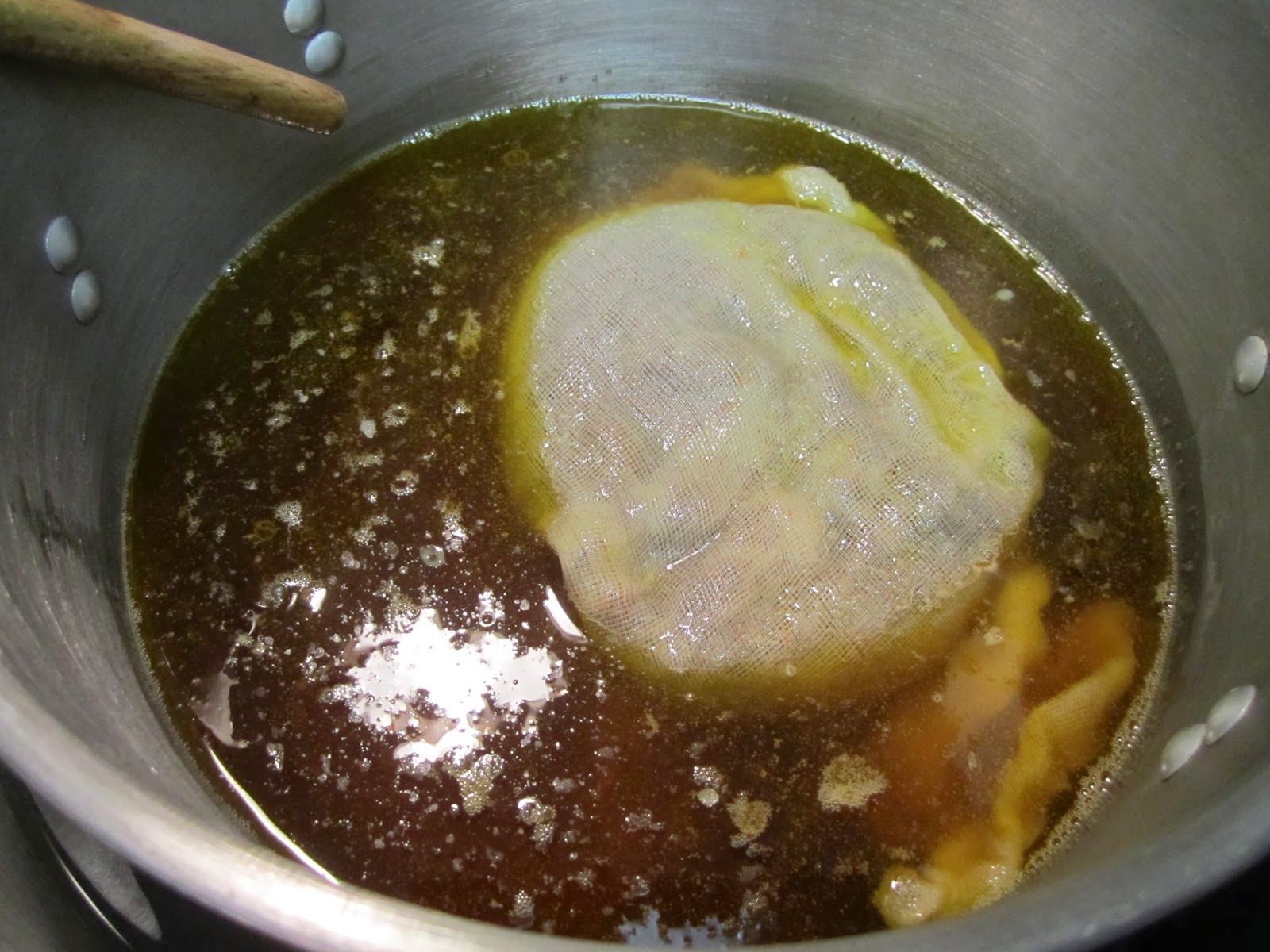
I brought the water up to a very gentle boil, and watched for about twenty minutes as the wax melted and formed a floating layer. I made sure to turn the ball of cheesecloth over to get all of the wax heated and melted, and stopped when it seemed that the volume of the bag was no longer changing. (Very scientific).

I removed the cheesecloth, pressing it against the side of the pot with a wooden spoon, and placed it carefully aside to cool, then turned the stovetop heat off and left the wax to harden.

The girls have still been flying in the sunshine - even though the temperature is below 10 degrees most days. I set the comb out by the hive entrance over three afternoons, and they cleaned all of the honey up for me. One girl had gorged on honey and lost track of time - I found her, apparently too chilled as evening fell, when I went to bring the pan in for the night. I heated her with my breath before convincing her to walk off of my finger back into the hive.


My first wax harvest. There is a bit of dusty debris on the bottom of the wax disc, but most was easily brushed away.
I'll be giving some to my neighbour, who makes herbal salves - she has been so accepting of all of our crazy backyard projects. I intend to treat myself to a small candle in one of my canning jars, and there will be enough left over for me to melt 'start your comb here' lines on the top bars for next year's hives.
Thank you girls!
Saturday, 28 September 2013
The Wet Coast
The furnace kicked in this week, signaling the end of sleeping with the window open at night, and planting a suggestion that I think of pulling my electric blanket out of the closet to warm my bed before I get into it at night. We keep our thermostat at 19.5, which is not 'comfortable' for most people, but electric blankets and space heaters take up some of the slack. Our house is drafty, and I don't want to pay for heat that I won't really benefit from.
The change in temperature also signalled that there were some chores that needed attending to. I did a full hive inspection on Thursday afternoon, when the sun was shining and the bees were going to and from the hive as fast as they could. (A few actually bounced off me when I got in the way of their mad scramble). I removed a couple of unused bars of drawn comb, to tighten up the interior chamber a bit, noted no queen cells (thank goodness!) and only about a dozen drone cells (so, no worry that the colony was thinking of moving out). Though I could not locate the queen, here were larva in various stages, in a brood nest that spanned the top of five bars, and pollen and nectar being stored - with some capped honey. Still, not enough. I moved the remaining bars to the center of the hive, to make room for the feeder at one end of the hive body, and today I made a thicker-consistency syrup that I will quickly put into the hive tomorrow, assuming there is a break in our rainy weather. With the way the hive is now set up, it's not too difficult or risky to quickly lift the lid and switch out new syrup bottles as needed over the next week or two.


The chickens are not impressed with the rain, and hang out under various tables, benches, in the gazebo where my seeds are drying, and even under the bee hive - but close quarters are leading to some lost feathers, telling me that not everything is peaceful. I continue to have all four girls settling into the chicken tractor at night, so I just have to hope that no one is getting seriously hurt when I see a pile of wet feathers scattered on the ground.

It seemed to take forever this year, but the Monkshood has finally bloomed, though the rain is doing a good job of pounding the tall stands of flowers. Still, they look lovely in contrast with the orange/yellow of the Black-eyed Susans which are still glowing in the rain.


The change in temperature also signalled that there were some chores that needed attending to. I did a full hive inspection on Thursday afternoon, when the sun was shining and the bees were going to and from the hive as fast as they could. (A few actually bounced off me when I got in the way of their mad scramble). I removed a couple of unused bars of drawn comb, to tighten up the interior chamber a bit, noted no queen cells (thank goodness!) and only about a dozen drone cells (so, no worry that the colony was thinking of moving out). Though I could not locate the queen, here were larva in various stages, in a brood nest that spanned the top of five bars, and pollen and nectar being stored - with some capped honey. Still, not enough. I moved the remaining bars to the center of the hive, to make room for the feeder at one end of the hive body, and today I made a thicker-consistency syrup that I will quickly put into the hive tomorrow, assuming there is a break in our rainy weather. With the way the hive is now set up, it's not too difficult or risky to quickly lift the lid and switch out new syrup bottles as needed over the next week or two.

As with my Spring feeding, this syrup includes chamomile tea, thyme, a dash of sea salt and some apple cider vinegar. This time, though, rather that an 1:1 ratio of sugar and water, the ratio is 2:1. The less water the bees need to evaporate for storage the better right now. Hopefully they will bulk up their stores a bit to make it through the colder months. The lack of drones shows that the queen is already streamlining the colony to make it through the winter. I put the bottom board on today, to cut down on the inflow of cold air, and will wait until it gets a bit cooler to limit the entrance holes from 3 down to 1, so the bees can still go out to forage as needed, or make cleansing flights on sunnier days. Ideally, we will be physically moving the hive back to its original position, where it will be more protected under the branches of the apple tree, and where I will ideally do a visual check each time I go to see the rabbits. Once the real winter weather is here, I'll just have to keep my fingers crossed that the colony has enough food stored to survive. I'll hang a branch across the entrance hole so that any bees emerging will reorient and make it back to the new hive site (fingers crossed). If we were concerned about larger predators, I could also tie the hive to the tree for stability.

The chickens are not impressed with the rain, and hang out under various tables, benches, in the gazebo where my seeds are drying, and even under the bee hive - but close quarters are leading to some lost feathers, telling me that not everything is peaceful. I continue to have all four girls settling into the chicken tractor at night, so I just have to hope that no one is getting seriously hurt when I see a pile of wet feathers scattered on the ground.

It seemed to take forever this year, but the Monkshood has finally bloomed, though the rain is doing a good job of pounding the tall stands of flowers. Still, they look lovely in contrast with the orange/yellow of the Black-eyed Susans which are still glowing in the rain.

I trimmed my potted perennials and berry starts back, checked labels, and tightened up most of my containers in their little corral. I removed several empty pots, which had either failed during the gardening season, or been eaten by curious chickens. I dug up a couple of new sorrel divisions, and will *not* be leaving them here where the girls can eat them... again. Some of the extra divisions, and some garden volunteers were planted out in the front yard, to help fill in spaces between existing plants and berry bushes. When it rains, it helps new plants settle right in. My seeding of winter rye is coming up nicely thanks to the weather.
I made some additional 'Greek' and lasagna casseroles to use up fresh herbs from the garden, before the cold turns them to mush. Chard stood in for spinach. Lots of chard. The final harvest of apples was sliced for a full load in the dehydrator, and the nicest fruit will be making a Dutch Apple Bread for sharing this weekend.

A quick grab of tomatoes in the hoop house today became an all-out harvest at the sound of the rain increasing. Because the fruits have taken so long to ripen, many have succumbed to blight or mildew. I quickly dunked the harvest in a bowl of water with a squirt of castile soap, and spread them out on a towel to allow them to dry and get some decent air flow while they ripen. The fully green tomatoes may not colour up, but I might finally get around to trying a fried green tomato recipe or two, just to use what we have managed to grow!

There are still some cherry tomatoes from the last picking, to enjoy with lunches over the next few days; some will be sliced and frozen, to be thrown into sauces over the winter. The other night we had a lovely treat of homemade, fresh salsa.

During the next break in the rain, we need to get the garlic, shallots and multiplier onions in the ground.
Tuesday, 13 August 2013
Bees and Bunnies
We went into the hive during a sunny break on Sunday, and were surprised when we found capped brood, but no other sign of a queen bee. The hive has a reprieve until next weekend at least, when we will check again to see if there is any sign that the hive is queen-right and things are progressing well - we have our fingers and toes all crossed. This is proving quite the complicated beekeeping experience.
Work continued on the rabbitry, and we managed to get frames installed and covered, that will eventually each house two large hanging cages for our rabbits to have more space and fresh air.


Sakura and Chun Li are both due to deliver today, and have built nests but have not yet begun to pull fur. I'll be checking on them all day, but they'll likely wait until tonight to have their kits.
Work continued on the rabbitry, and we managed to get frames installed and covered, that will eventually each house two large hanging cages for our rabbits to have more space and fresh air.


Sakura and Chun Li are both due to deliver today, and have built nests but have not yet begun to pull fur. I'll be checking on them all day, but they'll likely wait until tonight to have their kits.
Saturday, 10 August 2013
A Very Busy Day
At a week old, Jodie the chick is starting to get some wing feathers in, and is following her mother around the yard like an old pro, watching and learning. She can move surprisingly quickly, and hop into the garden beds, so she had a wonderful time exploring and digging - and eating what her mother found for her to try.

We were busy hauling lumber and working in the backyard, so we let the two of them out for a few hours with some supervision. Nugget took a couple of nips at the little one, so she went back in to the chicken tractor to consider her actions. Jodie observed Celine delighting in taking a 'dust' bath after being confined to the safety of the dog run on the grass all week, and joined in beside mom, wiggling herself into the bark mulch and sand. We stood and watched - it was absolutely adorable.

Work was started on the outside rabbitry extension today, and later chores included examining the hoophouse plants for damage while chopping back the squash, cucumber and tomato plants in there to encourage the ripening of the already-existing fruits and veggies. It could be a raccoon (?) The neighbour has had some of her ground-grown potatoes eaten, and that has to be a big disappointment. Could be the same opportunistic animal, as there are a lot of gardens in the neighbourhood, to tempt them, and we've run across both racoons and opossums in the yard. I was able to harvest quite a few cucumbers, so I'll need to find that recipe for dill cucumber slices soon (the problem with having too many preserving books sometimes!)
Tomorrow we hope to finish the building project, and I need to finish harvesting the potatoes we grew in buckets, and pot up some plant and herb divisions with the extra soil from that process. Some of the divisions are moving out to the front yard, to help fill in our plantings. I also plan to harvest the Alisa Craig onions which I grew from seed, and to tidy up a few eyesores which have been on the to-do list for a while, but ignored because of the oppressive heat of summer.


A hive inspection tomorrow (it was overcast until late today) will tell us whether the colony is indeed doomed, and then we will need to think about harvesting most of the honey and wax before our weakened colony is robbed. The girls are still working hard amongst the blossoms, and I want to find a balance between letting them cap their finished honey, and risking robbers finding the hive.
Subscribe to:
Posts (Atom)