Showing posts with label bunnies. Show all posts

Tuesday, 22 October 2013

Moving Day

 
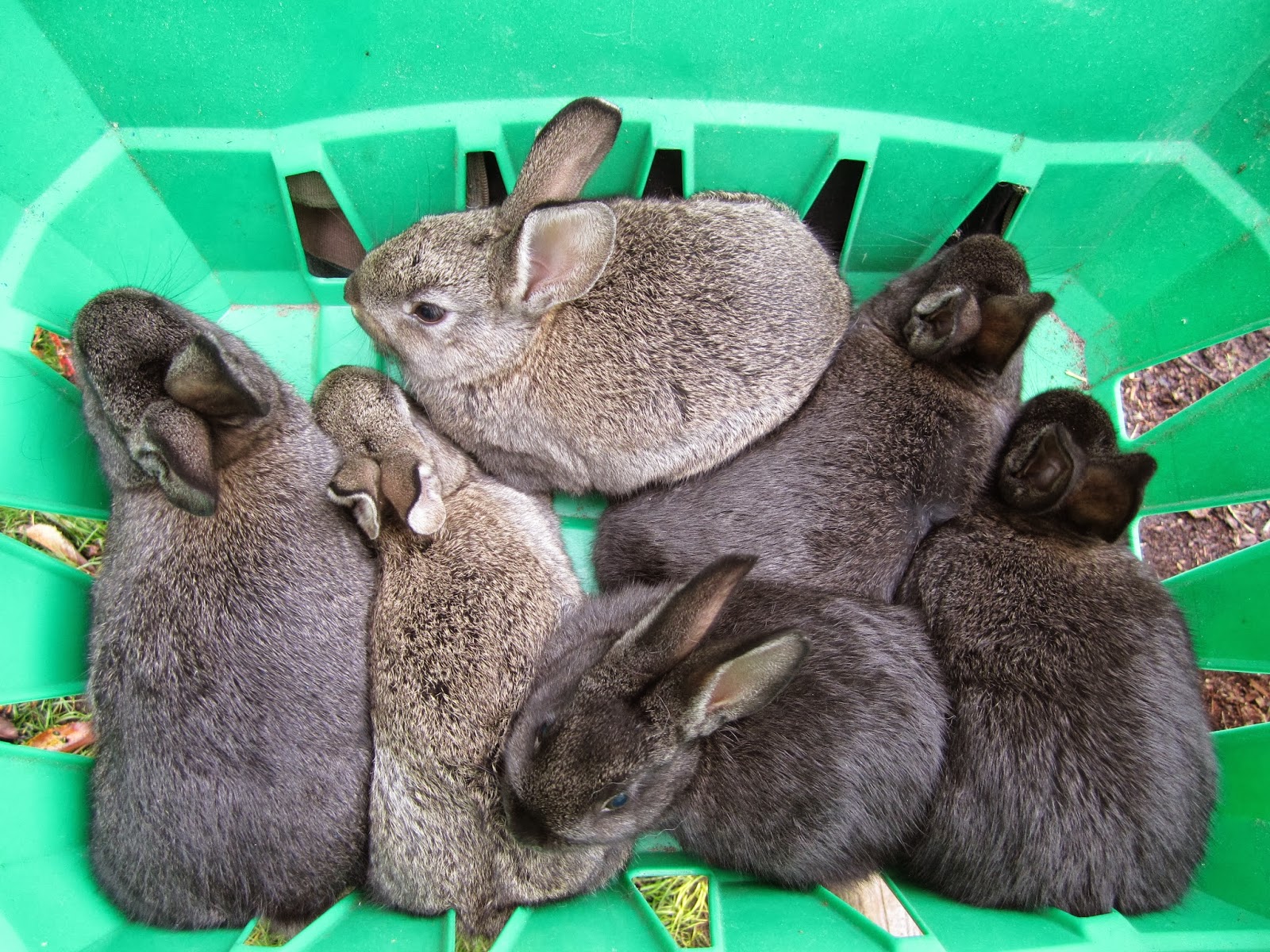
We spent some time over the weekend setting up more large cages, so that we could move mothers and their 5-week-old kits outside into the sunshine and fresh air.  The Florida White mothers will eventually go back inside through the colder months, but these cross-bred kits should have warmer coats, and the females we are keeping will spend the winter with a sister for warmth and companionship. We'll keep an eye on things, and offer straw and windbreaks if it becomes severely cold. The nights are cold now, but not freezing, and all of the bunnies are quite dry and warm when we feed them in the dark at 7 am.  All of the 10-week-old bunnies were weighed and sexed - though we'll be checking again to verify our findings.


Everyone settled right in and noshed on some apple branches as an afternoon snack.

Tuesday, 8 October 2013

Planting Garlic and Bunny Comparisons

This year was my first experience with garlic rust, which made me a bit leery about my planting of our saved garlic this Fall.  Research said that there was no reason not to plant our cloves, but I decided to be a bit more proactive, and dunked the newly-separated cloves in buckets of water, with equal parts bleach and liquid kelp to disinfect and give a boost to next year's harvest.  I used a scientific 'glug' of each in a bucket of about 2.5 gallons of water.

As I separated out the cloves, I dropped them into their bath, where I left them while I prepared the holes for planting.  My reading says that they can be left in the water for up to 24 hours, and that treatment can be followed by a dip in rubbing alcohol or vodka (neither of which I had on hand).


I know I'm not the only gardener out there who suffers a twinge planting the biggest bulbs of the harvest.  This clove is a hardneck variety, likely Music, acclimated over three seasons here. I decided to plant one bed of hardneck and one of softneck as opposed to last year's chaos.  It should make garlic scape season a little less like a treasure hunt. Throwback at Trapper Creek, who's in Oregon, says she finds her hardneck keeps almost as long as the softneck, and the cloves are so much bigger and easier to peel that she has a preference for it.  We like the look of braids, for which softnecks are required, but the disease meant I sent all the greenery to the garbage this time around, snipped half and inch above the bulbs.  Food for thought...

 
As additional guard against dealing with rust, I increased my planting distance from 6 to 8 inches, so there is more room for air movement between the plants in the beds. This also means I downsized our harvest from 180 heads of garlic to about 130. Multiplier onions and shallots still need to be planted along the edges (fall planting is an experiment this year, using saved bulbs from this season's garden).


While I was making holes, my lovely husband was digging finished compost out of our two black bins, and we had the perfect amount to cover everything up.  What I didn't take a picture of was the
actual finished beds - tucked in with floating row cover, bricks weighing down the corners to discourage chicken 'exploration.' Still to come is a chicken wire fence around the plantings - this one will be sturdier than what protected the barley crop.

The bunnies and kits are doing well, although the tattooing seems to be a bit hit-and-miss, as the ink is still wearing off.  Sunday Adrian took our biggest and smallest kits out of their nesting boxes for comparison at 17 days (hint: I've dubbed the grey one 'Gigantor')


And the real comparison:


Can I hear an awwwwww?

Friday, 5 July 2013

Of Bees and Bunnies

Yesterday, we processed our two recent litters of rabbits, while taking some time to show friends how to put down a rabbit as quickly and humanely as possible, and what comes after.  My farming/beekeeping/font of knowledge friend Jen dropped by, having run to the post office to pick up a queen bee that had been mailed overnight from Vancouver Island, and shared some personal tips and tricks about rabbit butchering.  All of us chatted and had a few positive hours of preparing home-grown meat for the table. I think everyone learned a thing or two!

I took a moment to discuss with Jen how we had determined that we no longer had a queen in our hive, and that our colony was likely doomed - knowing that the current bees would die off with no replacements being reared.

A few minutes after cleaning up after ourselves that evening, I received a call letting me know that the replacement queen from the Island was available, since the 'queenless' hive she had been meant for in Jen's bee yard had managed to produce their own queen after all, and things were ticking along.

Adrian and I quickly decided to ask for the queen - and a little bit of help as well. 

So, this morning, Jen came over with the queen in a little cage the size of a tic tac container (shipped via Canada Post Expresspost), and a frame of capped brood from one of her Langstroth hives.....


We shifted all of the top bars over, to make as much room as we could at one end of the hive, and placed the wood pieces which previously held the sugar syrup feeder, so we had a bit of a platform.


Jen had brushed as many bees off of a brood frame as she could, and brought the frame over in a pillow case for transport. Unfortunately for the bees that hitched a ride, our colony identified and killed them as intruders. It was a bit gruesome to watch.

 
Removing two of the built up top bars gave us just enough room to squeak the Langstroth frame in on an angle, and allow it to remain upright. 


The removed top bars, started with new, unused comb, went on either side of the foreign brood, in an attempt to insulate the brood, and to give a bit more security - and possibly to lend a reassuring, familiar scent to the remainder of our colony.


The queen was duct-taped to one side of the brood from Jen's hive, and the second top bar placed in front of her to provide warmth and security, while the bees from our top bar learn to recognize her scent and release her from her cage by eating the candy cap at one end.


We covered this decidedly unconventional compromise with a burlap sack, before putting the lid back on the hive, and this evening I will go in to (hopefully) verify that 1. Our bees have not killed the new queen, and 2. That they are congregating around her protectively and feeding her while they accept her leadership.
 
Thank you Jen, and here's hoping that our emergency measures help our hive to regain its lost numbers.
Friday, 14 June 2013

Ten Days Later

There's little sign of new brood in the hive, but we have three capped queen cells to hopefully provide a new, strong queen for the colony in the next week.  A friend observes that we may have had a quick swarm when we weren't looking, which would explain the lower-than-expected numbers of bees present in the hive, and the lack of new brood.  The queen may very well have left the building, and the strongest of the new queens will hopefully have a successful mating flight and lead our colony into a season of honey production and preparation for the fall and winter.  The rainy weather won't be ideal for a good flight, but it looks like next weekend might bring sunnier days.

The honeysuckle is blooming, and I love wandering in the garden right now, and smelling the scent in the breeze. Kale, chard, turnips and spinach are ready for harvest, and there are a few peas making an appearance after an early April planting. I've switched over to pole beans for now, and may seed more peas this fall in the few empty feet of trellis space once the weather cools down again.

Speaking of cool weather, as my father-in-law said the other day, it's been great for people who don't like extreme heat,  but not great for the vegetables that need it.  The tomatoes, peppers, eggplants and zucchini are growing ever so slowly in our hoop houses, though my neighbour does have some blossoms and small fruits on some of her squash and tomato plants.


Berry picking is starting up, with black currents and strawberries starting off the season - gooseberries, raspberries and blueberries are showing promise of good crops as well. Freezing of daily picking has begun, in preparation for jam making later in the year.

The bunnies are happy and healthy, though decidedly smaller than some of our previous animals. Feeding them a variety of greens makes us feel like they have more enjoyment of their day, but it does affect the amount of weight gain we see on butchering day. Some of the kits are quite plump, while a few are very light -  and they only have two weeks left to grow.  We're looking at possibly crossbreeding our Florida Whites with a friendly Champagne D'Argent buck in an effort to produce a calmer, slightly larger animal. Time will tell.

Thursday, 2 May 2013

They're Aliiiiiiiiive!

Today was sunny and warm. The honey bees were buzzing about, and we gave the momma rabbits some outside time with their little ones. A check in the 'attic' of the mason bee house confirmed what I thought I saw - that some of the cocoon inhabitants had made their way out into the great, wide, warmer world in search of pollen and a sip of water or nectar.


If you look closely, you can see the holes made in the cocoon walls by the emerging bees.

The apple trees have slowly begun to blossom, much later than the pear and cherry trees here.


One of the girls from the honey bee colony is at work collecting pollen from an apple tree - and below in a clematis flower.


What a lovely day!