Showing posts with label chickens. Show all posts

Saturday, 6 June 2015

Which Came First?

In the case of our chickens and their proper housing, the answer would unfortunately be the chickens.  Having raised 3 chicks from day-old before, neither of us were worried about handling a new group of young, locally grown chicks.  We had settled on 16 chicks (8 Australorp, 8 Welsummer), knowing we would likely have several roosters in the bunch.  We needed to make sure we had enough hens for the egg production we hoped for.  We also knew we would need to raise them in the house, as we have no secure outbuildings, but certainly we would have a coop and run ready for them by the time they had feathered out......?


I picked up our 16 chicks from a hobby farm south of us in Duncan, in the first week of April.  We settled them in a Rubbermaid container with food, water, and a heat lamp, and watched them be adorable peeping balls of fluff.


While they spent most of their time eating, pooping, scratching shavings into their water and sleeping - keeled over on their faces for a lot of the time - we planned and built a larger brooder for them to inhabit.


We built big, knowing that in the future we would likely be using it for 40-50 chicks over several weeks' time, and designed it with a divider down the middle to allow for more options with brooding different groups, or for use with a couple of broody hens if needed.  It's assembled with bolts, so it can be stored relatively flat when not in use.

Then, we got started on the 'real' chicken house.  This is the last project to be started in our scary workshop before the building is demolished - it's the flattest spot on the property, given the cement floor, so I'm not sure how we'll manage until we've saved enough to build again.  We assembled the base of the house, covered with linoleum for ease of cleaning, and mocked up the wall framing as best we could so that we could assemble it on site.


We built nest boxes to attach off the back of the house so they won't take up valuable floor space. The build is roughly 8x4, minus the frame, so the maximum capacity for this coop should be about 10 chickens.  We're temporarily housing more while we 'audition' roosters.  There is an attached 10x20 run we've covered with 2-inch stucco wire, to provide them a space protected from the ravens, eagles, and goshawks that might find them a little too interesting. There are also mink and raccoons to think about - even bear and cougars - but we've constructed the coop itself to lock down rather tight at night, and raised it off the ground to prevent digging in.  One can hope that there are other sources of food that would be less trouble to access.  Once the flock has learned where to eat and drink, and roost at night, we can carefully give them daytime access to the additional area outside their run, enclosed by electric net fencing.  Hopefully the rooster we select to keep will be good at keeping an eye out for predators, and there are trees and space under the rabbit hutches in the enclosure for the chickens to find cover if they need it.

In order to prepare the site for the coop, we spent quite a bit of time digging, leveling, and scratching our heads.  I bought a bigger level, just to get it right.


Which only served to show us just how off level everything else is....


Trim work and paint went a long way towards making the coop presentable, and giving it the illusion of being square.  We've added 1x4 boards at the doors, to keep shavings and poop inside the coop until clean out, and we will be adding plastic bins to the nesting boxes, for ease of cleaning.


The wired run is now attached to the front of the coop, and hardware cloth and 2-inch square wire surround the base, to give the chickens a dry covered place for dustbathing in the heat of the day.  The enclosure wire extends 6 or more inches out from the bottom, and is screwed tight to the frame, then pounded into the ground with tent pegs.  Hopefully this will discourage digging by any predators curious enough to make their way past the electrified perimeter.


The chickens are outside and loving it now - and it only took us 2 months to get things sorted out.  Word to the wise - keeping 16 chickens in the living room is not an ideal situation.  Oh, and the current estimate is that we have 6 hens and 10 roosters.  It's going to be interesting.

Thursday, 7 November 2013

Good Luck Celine

Adrian has been very gentle and understanding with me for the last couple of days as I dealt with the shocking loss of my backyard girls.  There were kind messages in response to his post on Facebook, and I wanted to thank everyone for their sympathy.  A lot of people have been introduced to our backyard animals - learning how we keep bees, checking out the chicken tractor, seeing what we grow for the animals in a small space, and of course, petting bunnies (by far the most popular part of a visit).  These animals are important to me, and the quality and manner of their lives and especially of their deaths is something that warrants a lot of my consideration. It's taking me some time to deal with the sense that I failed to protect them.  I resolve to do better.  We will try to always have a Naked Neck Turken named Nugget in our flock, in memory of our hen who jumped for blueberries.

Celine went to a new home in Langley, meeting a clique of larger white girls who put her in her place, another smaller, tan hen who protected her when the bullying came to her attention, and a diminutive bantam rooster named Eddie, who danced for her within the first 15 minutes of her arrival.  He's about half her own, small size, and apparently very protective of his flock.  I checked in with her adoptive family this afternoon, and she is settling in as well as a new chicken can settle into an established flock.  She is allowing some handling and cuddles, and being placed on a roost at night, to show her the new set up of her quarters and help her adjust.

Tuesday, 5 November 2013

A Terrible Day On The (Suburban) Farm

It was just yesterday that I was looking out the kitchen window at my small flock of chickens rooting about under the blueberry bushes - they were exploring their extended territory now that I had pulled the last of the tomatillos and covered the crops that I wanted to protect. The world - and offerings of parsley, chard, kale, strawberry plants and fresh dirt to dig - was open before them. I was smiling at how lucky I was to have my own little illicit farm in a residential backyard, and taking note that Jodie the troublemaker seemed to be eying the height of the back fence.  This morning I went out as the sun rose, to let the girls out for the day, and as I went around the corner calling out to them, I came upon a terrible scene of destruction. It took a moment for my brain to register what I was seeing. Something had managed to unlatch the door to the nesting box in the night.  Pilgrim was dead, all that was left of Jodie was a mess of feathers and bones, and Nugget was terribly gored, struggling to breathe.  Celine was huddled at the front door, spattered with someone else's blood.

I yelled for Adrian, and he quickly ended Nugget's suffering, and I scooped up a dazed Celine to check her for signs of fatal damage.  We both stopped for a moment and stood there, stunned.

These are not the first chickens we have lost.  Patty died unexpectedly in the night, Strip took to hiding in the bushes, determined for days to keep her eggs to hatch, and we were unable to find her on a day we were heading out of town.  She fell prey to a predator, unprotected overnight.  Breakfast, one of our original 3 hens, was dragged from the coop in the night - our first loss and the reason we set up an additional wire barrier underground in the winter.

We maintain a habit of doing a head count and locking everyone in at night to make sure that no one has decided to lay eggs in the bushes, or roosted on the stairs to the back deck.  The days are short now though, and the nights are cold.  The chickens had instinctively taken to returning to the relative warmth of the coop long before I went out to check them for the night, and as I patted 4 chickens in the growing dark last night, I know that I secured that latch. 

I put out a notice to rehome Celine to a small local flock.  I have her nested in the dark foyer in a carrier with straw, water and food, but she is obviously out of sorts and in shock. 

Update: A nice lady in Langley called, and I will be taking Celine to her new home this afternoon.  She will be joining a small flock of mixed bantams that have outside access when people are about and a protected run to discourage predators.  After a bit of quiet time, she will roost with her new flock mates this evening, and by morning she will begin the process of finding her place in a new social structure. 

Tuesday, 22 October 2013

Containment


Twice this past weekend, I looked out the window to see chickens digging in the garden, past the gates and wire and trellising...out in the no chicken zone.  Granted, our lean-to wire panels are nothing that a toddler couldn't move out of the way, and one of them now has a big hole (presumably from a startled racoon or similar backyard visitor), that has been handily - if not prettily - covered by a piece of plywood.  Hey, we're on a budget here.
 
 
The guilty girls.  The first time, Adrian went out and shooed them back to their part of the yard, but when I saw them in the back a second time, I realized they had to be hopping over the fence to get into the no bird zone.  The garden beds back there hold some of my winter greens, which the chickens could dig up in a very short time, as well as winter rye I've planted for the rabbits. 
 
This summer, the goal was to keep them from denuding the blueberry bushes and annoying the neighbour's dog (who barks every time she sees us in our kitchen window).  After I've taken some steps to protect my winter greens, I'll open the area up for the chickens, whose attentions will help to rid me of any pests in the mulch around the blueberry and black currant bushes - though they'll probably dig up more than a few of my strawberry plants at the same time.  Either way, chickens don't understand 'later.'
 
 
Jodie just turned 11 weeks old on the weekend, and she's fully feathered with what I think of as Araucana cheek feathers. She's not too pleased with me in this picture.

 
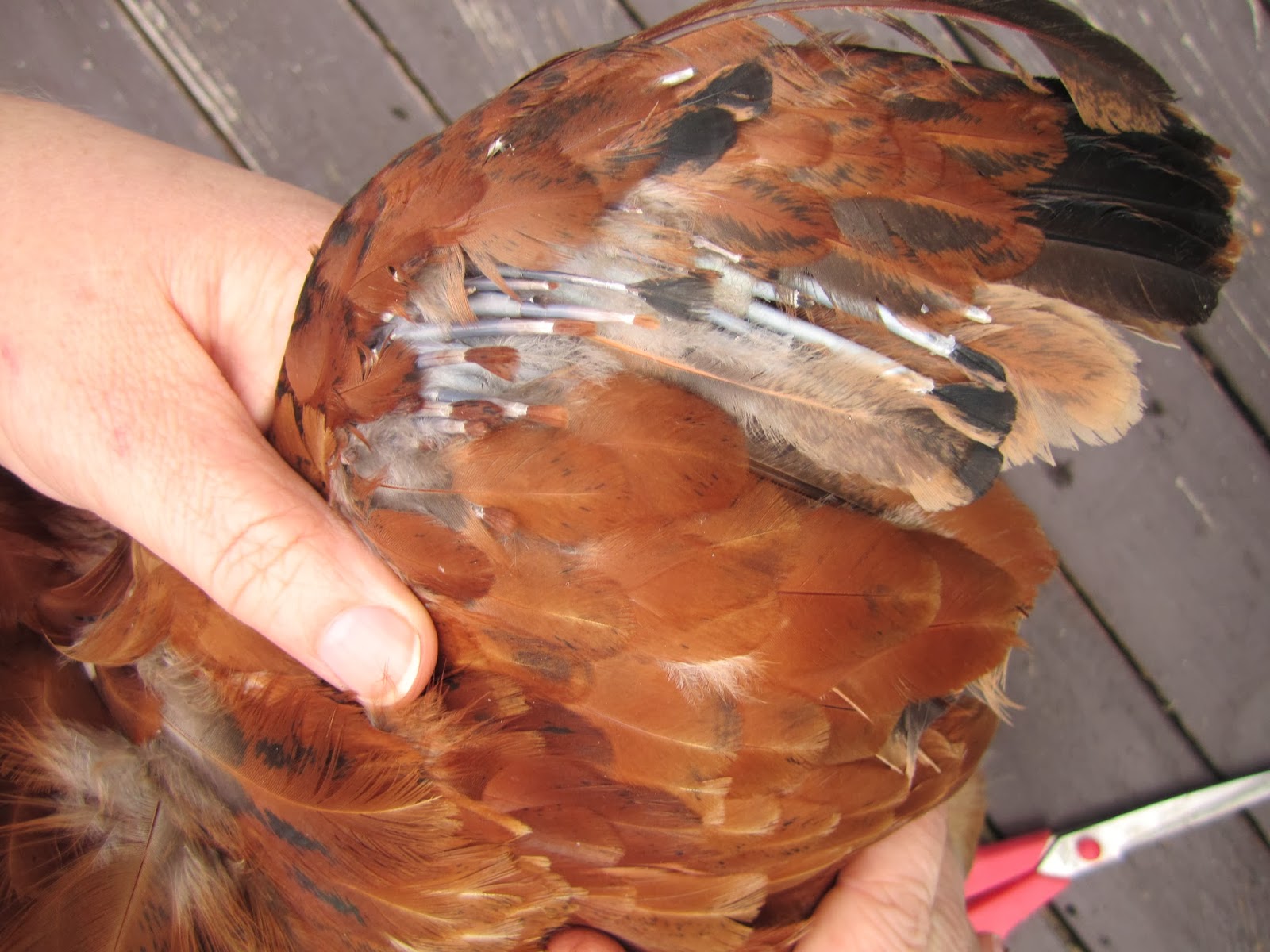
I've clipped the girls' wings before, but as I checked Celine's feathers I realized they'd had quite some time to grow back.  Jodie has her original flight feathers, so she'd likely encouraged her mother to  hop the fence for greener pastures.


It doesn't look pretty, but cutting only the ends of the wing feathers off is similar to clipping a human fingernail - the ends are not supplied with blood after they have grown out, and the clipping unbalances a bird, making flight awkward.  The birds eventually molt, and new, full wing feathers grow back in.

 
Nugget and Pilgrim don't have the full use of their clipped wings yet.  Here you can see Nugget's feathers being replaced by new growth, so all of the feathers lost in the yard out there weren't just from disputes about the pecking order.  I'd just realized that Pilgrim is looking a little ratty as her new head feathering comes in.

 
All four girls, walking the fence line with the neighbour's garden, and wishing they could get in there to dig up that dirt and look for bugs.  I'm glad to make certain they can't since there are also two dogs sharing the yard.

Tuesday, 8 October 2013

Winter Is Coming

Over three days on the weekend, the hoop house went from its summer job as a growing area, to its winter service as a home for the chickens.  I hauled out the tomato cages, pulled vines, harvested *the absolute last* tomatoes, and Adrian managed to fit all of the greenery into the yard waste bin.  Because we cannot burn the tomato vines, and they can carry virus or disease from one season to the next, we send them to the city where their larger, turned compost pile will heat up much more than ours every could.


After cleaning the rabbitry, Adrian dumped the excess sawdust, wasted greens, and rabbit droppings onto the dirt, and topped that with fresh straw.  Over the winter, the chickens will add their own contributions to the straw, which will balance the nitrogen, and they'll scratch through all of the dirt; we'll add more straw, and they'll break down the waste, fertilizing the site for next year.  The dirt-covered frame under the chicken tractor has several passes of chicken wire to protect the girls from predators burrowing in - we learned that one the hard way.


While he was busy with that, I scrubbed and hosed out their living quarters, which are holding up quite well I think, for being built by newbies who had never built a chicken tractor or kept chickens before.  Of course, I should add that we had friends to help us through some of the process, though they'd never done anything like this before either. Tell you what though, we'll never build something this heavy again - whew!  Adrian was kind enough to crawl underneath, and attach their heat lamp and heated water bucket for the cold months, and voila!


Then we just had to wrangle the chickens into their winter digs....... I only had to chase them around the hoop house once!

Saturday, 3 August 2013

Wins and Losses

You know how they say 'don't count your chickens before they're hatched?' I had a feeling that we weren't going to see a big outcome from the eggs that Celine has been sitting on.  We didn't have space to give her the privacy she wanted, and the other two girls have been pushing her aside because they *need* to lay in the same nesting box - not the one right beside her! I merely wanted to give her something to focus her attention on, since she seemed so darned determined to set.

She is still sitting on 5 eggs, which I doubt will hatch out for any number of reasons. This morning when I went to check on her and give her breakfast in bed, I could hear a muffled peeping.

 
Egg number six hatched into a tiny chick.
 
I had to move Celine aside - and she was not pleased - to get a good look at this little fluffball, and have now moved them to a small dog crate in a mobile dog run, lined top and bottom with chicken wire, topped in a tarp for protection from the elements and predators (and perhaps the other 2 chickens).  My neighbour laughed and waved me off when I apologized for my scrappy chicken/chick run, which she can see from her porch.  I moved the unhatched eggs into the 'nest' as well, and will let Celine have them for 2 more days before I remove them and let her focus on her foster chick.  Hopefully, her instincts will extend beyond keeping an egg warm, or I will have to take over as mother. Chicks can survive without food or water for three days after hatching (having eaten their way out of the shell), but I will hopefully see Celine encourage the little one to drink some water and eat the chick starter I have placed in the run with them.
 
While I was out in the yard, I donned my bee veil and gloves, and hesitantly opened the hive. 
 
No new brood, no sign of a queen.  I think we've lost the colony.  Still an amazing experience, and we're not giving up!


Monday, 29 July 2013

The Birds And The Bees

Well, the bee hive continues to be a big question mark for now.  I confirmed that the queen had emerged from her cell, removed the langstroth frame, and added a couple of bars (for new building) with minimal manipulation on Monday.  On Saturday, we did a more thorough inspection of the hive, hoping we might observe the queen or evidence of new brood.

Nothing.

We didn't see any sign of Queen number 9, but we also observed normal, calm hive behaviour with a bustle of activity and no aggression.  I'll take that as a good sign, and leave things be for another week.  There aren't a lot more options now, as we are reluctant to buy another queen after losing our import to begin with, and it's getting rather late in the season for nectar flow and re-building the colony numbers.


Celine is still sitting on her eggs, and we *could* see chicks by the weekend.  We've set up a temporary shelter to move her (or likely the 2 older girls) into if she manages to hatch out any little ones.  We did attempt to candle the eggs to identify if we have any potential chicks on the way, but with very little experience and a normal flashlight, I couldn't say for sure what I was looking at.  Two of the eggs appear to match online diagrams showing a late death at 10-16 days, but I'm unwilling to risk viable eggs due to my own uncertainty. I won't be jostling the eggs again until I am sure they are no longer viable.

Another sunny, dry day in the garden... I broke down and got out the sprinkler on Sunday to supplement the drip irrigation lines.

Saturday, 27 July 2013

Late July Update

Well, it's been just over three weeks for my gooseberry cuttings, and there was a 50% success rate, which I'm perfectly happy with.  There is evidence of good rooting, and new growth.


The blueberry cuttings are starting to look a bit questionable, but I'll keep watching and watering.  The lavender and hydrangea cuttings seem much happier. I'll be taking cuttings of the currant bushes as soon as I locate my bottle of rooting powder (?!) It's probably somewhere with my spare set of pruners and the gardening gloves I can't find...

In the hoop house, everything is growing like crazy - though more with leaves than with the vegetables I'm waiting for.  It's true that a lot of gardeners judge their gardens by when they have their first tomatoes, and I'm running behind.  The neighbour has already been eating ripe, red fruit - from tomato plants that I gave her (which makes my impatience slightly worse).  Her plants are falling over with fruit, while mine are just showing a few per plant. She dug up the side lawn and plopped them into the ground, while I added rabbit manure, topsoil eggshells and manure tea! It just goes to show that you can't account for all the circumstances in your garden.  Heading into week 6 without rain certainly isn't helping. This is one of the Siletz plants I have my eye on:


Oh well - there's still weeks to go for the tomato season. Just as I'm not terribly sad to see the blueberry bushes finishing up their production for the year, we'll soon be harvesting tomatoes daily in the heat, and wondering what to do with them all.  At least I'm starting to harvest the zucchini and cucumber crops, and the bees are helping with that. I've never managed to have enough cucumbers ripen at once before, for making my pickles - I've bought my supply at the farmer's market. This year may be the first year in my gardening history that cucumbers - and homegrown dill - are ready for pickling in adequate quantities at the same time.


The leaves of the shallots and multiplier onions started to fall over, so I finished harvesting them this morning.  They'll cure outside in the sun for a couple of days, then go into the carport to finish drying with the garlic bulbs (which have already had a preliminary cleaning). The biggest of these onions will be planted back into a freshly-prepared garden bed (after the wheat is harvested) at the same time as we put out our garlic in October.

 
The bed that was hosting our garlic plants and peas is now home to chard, kale, kohlrabi, lettuce, pole beans and some peas planted for harvesting as pea tips. The transplants were getting a bit root-bound waiting for more space, so I've got my fingers crossed that they will establish themselves and not bolt to seed. The Jerusalem artichoke in the background is flourishing - and escaping into my pathways as it tries to expand its territory. That's fine, as the rabbits are happy to eat the invaders.

 
Celine is still sitting on 'her' eggs, so we're counting down another five or six days and hoping to hear the peeps of a few baby chicks.  I'm prepared to house mother hen and her little ones in a dog kennel and covered run, if the other adult hens seem intent on interfering or harming them.

Saturday, 11 May 2013

Happy Chickens

We've been working to get the garden ready for the new planting season for a few weeks now, moving mulch and topsoil, weeding beds and repositioning volunteer plants. The tomato, squash and cucumber seedlings have been hardening off for the past several days, and are almost ready for transplanting.

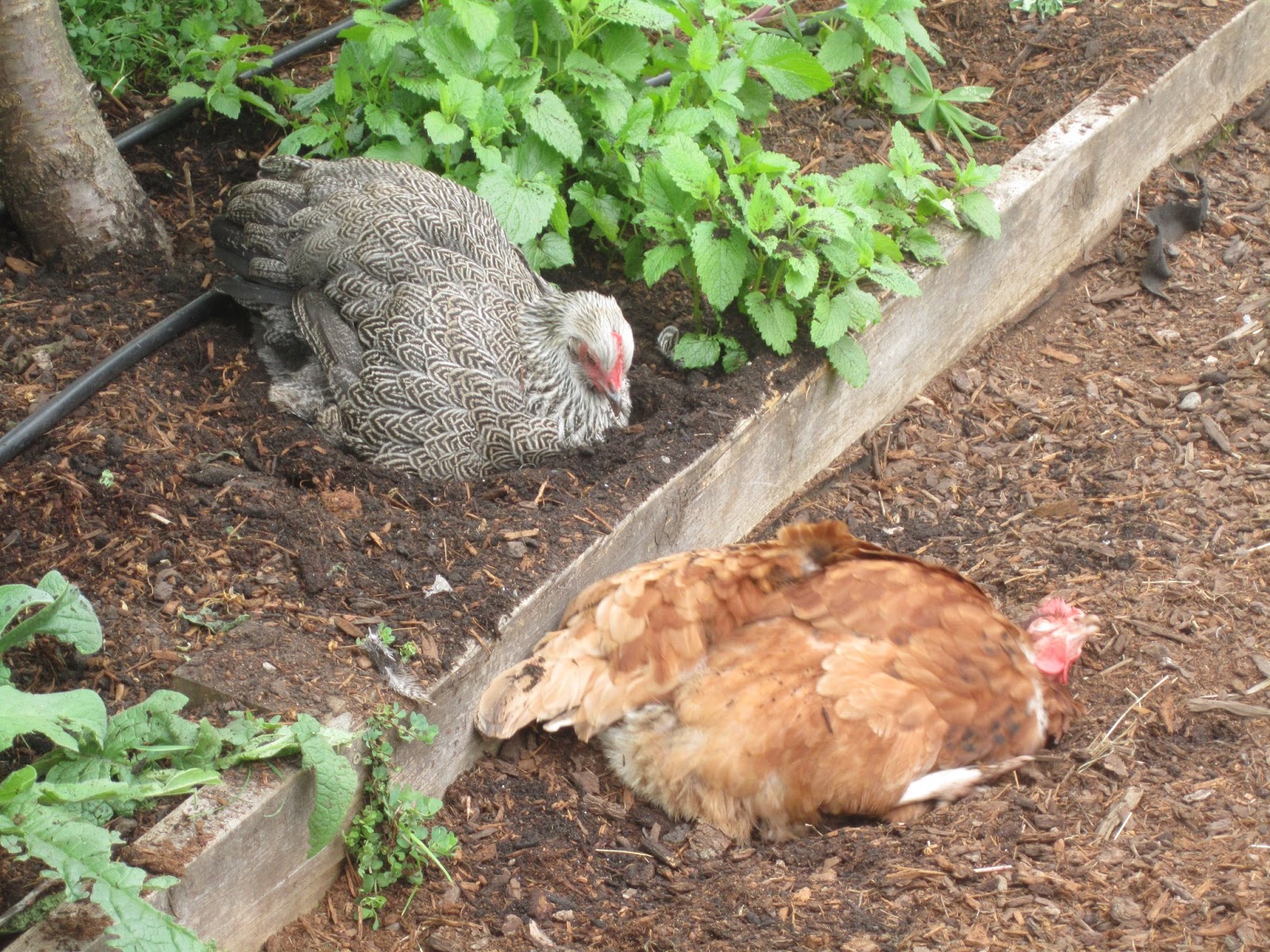
On the other hand, while we make everything neat and tidy, the chickens are following behind us and creating their own idea of perfection - like trimming all of the barley they can reach through a wire barrier put up to exclude them, nipping bites out of all of my comfrey leaves, and making dust-bathing holes in the middle of my nicely-mulched garden.


They just look like they're having such a good time...I can neaten up later.